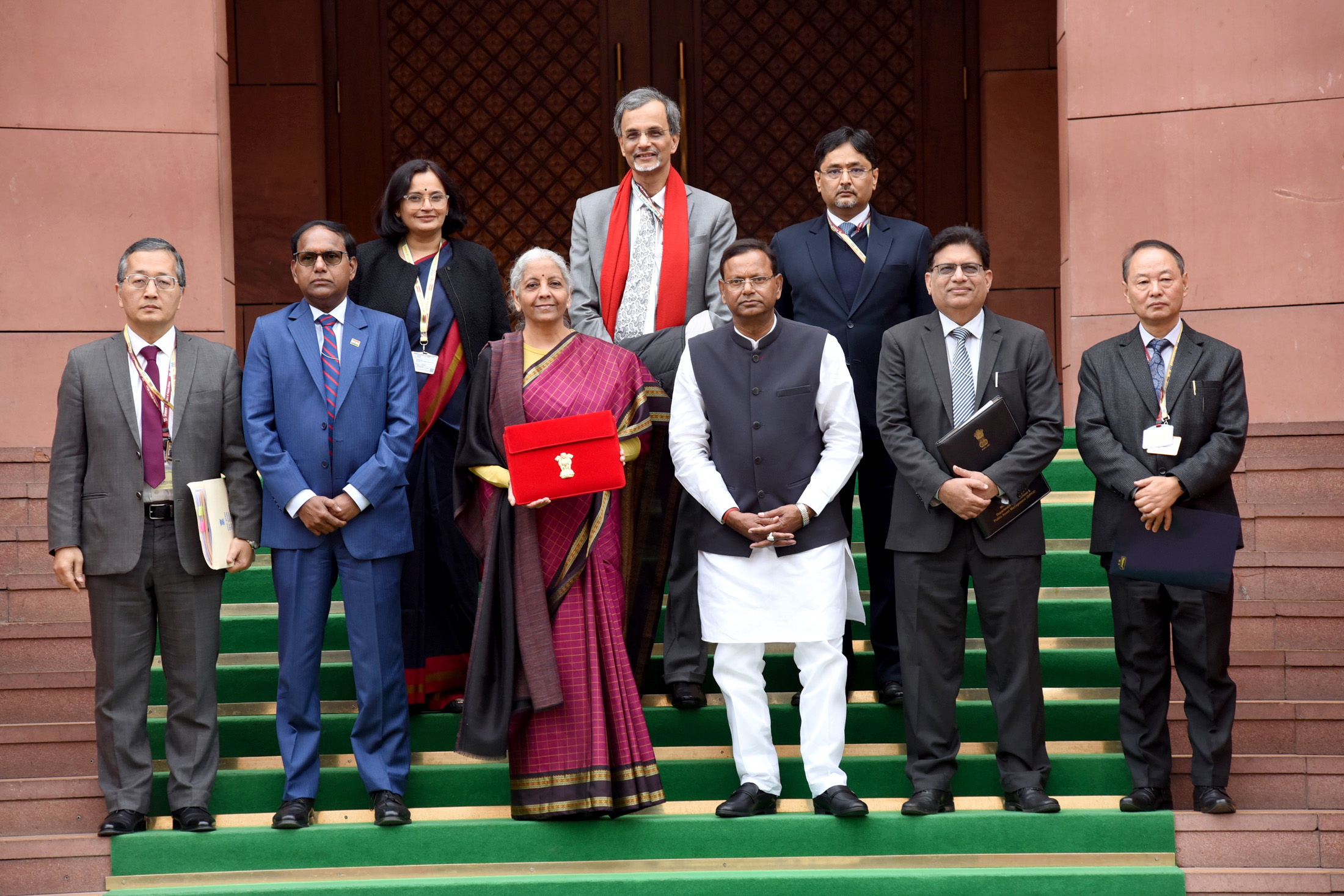
Finance Minister Nirmala Sitharaman proposed several measures to boost the country’s technology and electronics sector.
The Finance Minister announced the launch of India Semiconductor Mission (ISM) 2.0 to produce equipment and materials, design fullstack Indian IP, and fortify supply chains. “We will also focus on industry-led research and training centres to develop technology and skilled workforce,” she said.
The Electronics Components Manufacturing Scheme, launched in April 2025 with an outlay of ₹22,919 crore, already has investment commitments at double the target. The Budget proposed to increase the outlay to ₹40,000 crore to capitalise on the momentum.
The Budget recognized India as a global leader in software development services, IT enabled services, knowledge process outsourcing services and contract R&D services relating to software development. As these business segments are quite inter-connected with each other, all these services are proposed to be clubbed under a single category of Information Technology Services with a common safe harbour margin of 15.5% applicable to all.
The threshold for availing safe harbour for IT services is being enhanced substantially from Rs 300 crore to Rs 2,000 crore. Safe harbour for IT services shall be approved by an automated rule-driven process without any need for tax officer to examine and accept the application. Once applied by an IT Services company, the same safe harbour can be continued for a period of 5 years at a stretch at its choice.
Recognising the need to enable critical infrastructure and boost investment in data centres, Sitharaman proposed to provide tax holiday till 2047 to any foreign company that provides cloud services to customers globally by using data centre services from India. It will, however, need to provide services to Indian customers through an Indian reseller entity. She also proposed to provide a safe harbour of 15% on cost in case the company providing data centre services from India is a related entity.
The Budget recognised India’s Animation, Visual Effects, Gaming and Comics (AVGC) sector to be a growing industry, projected to require 2 million professionals by 2030. The Finance Minister proposed to support the Indian Institute of Creative Technologies, Mumbai in setting up AVGC Content Creator Labs in 15,000 secondary schools and 500 colleges.
The Finance Minister proposed to launch Bharat-VISTAAR, a multilingual AI tool that shall integrate the AgriStack portals and the ICAR package on agricultural practices with AI systems. This will enhance farm productivity, enable better decisions for farmers and reduce risk by providing customised advisory support.
IT sector reactions:
Raju Vegesna, Chairman & Managing Director, Sify Technologies Ltd.
“The Union Budget for 2026-27 emphasizes accelerating India’s AI journey and strengthening the country’s data center infrastructure. This focus is timely and forward-looking. The Budget combines long-term tax incentives for cloud and data center investments with a broader push for digital infrastructure and innovation. It recognizes that high-quality computing capacity is now crucial to India’s growth, just like roads and power.
“As a home-grown, AI-ready data center platform with a growing presence in India’s key digital hubs, we see these measures as a positive sign for sustained, cost-effective capacity creation. They also promote deeper partnerships with hyperscalers and faster cloud adoption by enterprises. These initiatives will allow us to continue investing in energy-efficient, high-density infrastructure that supports India’s AI workloads, protects data sovereignty, and helps global and domestic customers run their most demanding applications in India. Overall, the Budget supports a long-term, demand-driven vision for the country’s digital infrastructure sector, which aligns with our goal of building India’s trusted, large-scale colocation and AI infrastructure platform,” Vegesna said.
Sachin Panicker, Chief AI Officer, Fulcrum Digital -
“The Union Budget 2026-27 recognises that artificial intelligence is no longer an experimental technology but a strategic lever for governance, productivity and economic growth. It has specifically highlighted AI applications to enhance governance and introduced measures such as the AI Mission, National Quantum Mission and significant new funding through the Anusandhan National Research Foundation and the Research and Development and Innovation Fund. At Fulcrum Digital, we believe the 21st century’s true potential lies in shifting from simple automation to Intelligence Amplification (IA). By backing R&D and innovation funds, the government is providing the essential fuel for enterprises to move beyond experimentation to real-world, scalable impact.
“Equally important is the decision to substantially enhance the safe harbour threshold for IT services from ₹300 crore to ₹2,000 crore, which will significantly reduce compliance friction and improve operating certainty for a much broader set of technology firms. This move aims to strengthen India’s technology ecosystem by expanding research capacity, supporting translational innovation and building future capabilities in sectors such as agriculture, healthcare, education and public services. For this framework to create measurable impact we need coordinated implementation with industry and academia, greater focus on data and compute infrastructure, and skilling pathways that align with the evolving demand for specialised AI talent.”
Arundhati Bhattacharya, President & CEO, Salesforce South Asia
“Budget 2026 represents India's transformation from technology consumption to AI-powered innovation—a blueprint for a $7 trillion economy built on intelligence, not just scale. The strategic architecture is balanced and long-term. The tax holiday until 2047 for cloud services is a masterstroke in data sovereignty, attracting an estimated $50 billion in data center investments by 2030 while positioning India as the cloud hub for emerging markets.
MSME reforms demonstrate sophisticated thinking. The ₹10,000 crore SME Growth Fund, combined with the TReDs platform mandate and expanded safe harbor thresholds, creates force multipliers enabling India's 63 million MSMEs to scale from survivors to global champions.
The High-Powered Committee on Education to Employment targets capturing 10% of global services trade by 2047—ambitious but achievable given our demographic advantage: 65% under 35, digital infrastructure like UPI and Aadhaar.
AI integration is refreshingly pragmatic. Bharat-VISTAAR's multilingual agricultural platform and AI in school curricula show generational thinking, ensuring our demographic dividend becomes an intelligent dividend.
We see the Budget as a structural roadmap that creates an environment where technology, enterprises, and individuals can unite to collectively propel India's future advancement. However, the critical gap remains R&D investment, we risk becoming sophisticated consumers of AI rather than creators.
The Union Budget's design powers national growth, driven by AI, cloud sovereignty, and innovative digital platforms. This technological foundation is key to defining the future of growth, and Salesforce fully embraces this opportunity.”